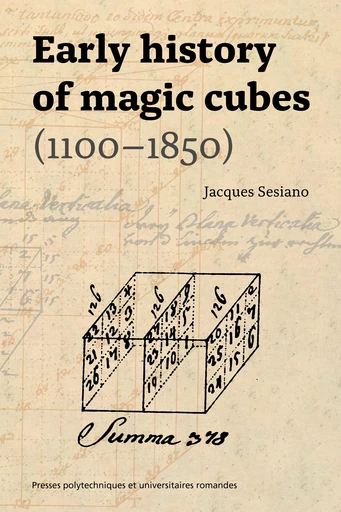
Early history of magic cubes (1100–1850)
Medias
Présentation
The history of magic cubes is generally considered to begin in the second half of the 19th century, when the conditions for a cube to be called magic were established: it must display the same sum in each horizontal, vertical and front-to-back row, as well as in the four internal diagonals of the cube.
However, during the preceding seven centuries, constructions of magic cubes had been already carried out, but obeying other definitions. The first study is found in 12th-century Persia. Then, Fermat dealt with them in the 17th century. Unaware of the existence of predecessors, and with a different definition, the Frenchman Sauveur taught a construction method that was adopted in Leibniz’s circle. This method was expanded in the 1830s, but fell into oblivion with the modern definition of the magic cube.
Sommaire
- Preface
- Table of contents
- Chapter I. Magic squares
- Chapter II. Magic cubes in general
- Chapter III. Khazinii’s treatise on magic cubes
- Chapter IV. Fermat’s magic cube
- Chapter V. Sauveur’s magic cubes
- Chapter VI. Magic cubes in Leibniz’s circle
- Chapter VII. Violle’s magic cubes
- Bibliography
- Index
Informations
Éditeur : EPFL Press
Publication : 7 août 2025
Édition : 1re édition
Support(s) : Livre papier
Nombre de pages Livre papier : 360
Format (en mm) Livre papier : 160 x 240
Poids (en grammes) : 620
Langue(s) : Anglais
EAN13 Livre papier : 9782889156993

Du même auteur

45,00 €

À partir de 37,00 €



24,00 €

44,00 €
Ils ont aussi acheté

À partir de 0,00 € (gratuit)

29,00 €

29,00 €

14,90 €

À partir de 0,00 € (gratuit)

À partir de 0,00 € (gratuit)
Sur des thèmes similaires


35,00 €

Rob Phillips, Laura Ferrarello
À partir de 0,00 € (gratuit)

42,00 €

50,00 €